
The Values on Your Website Are Lying to You
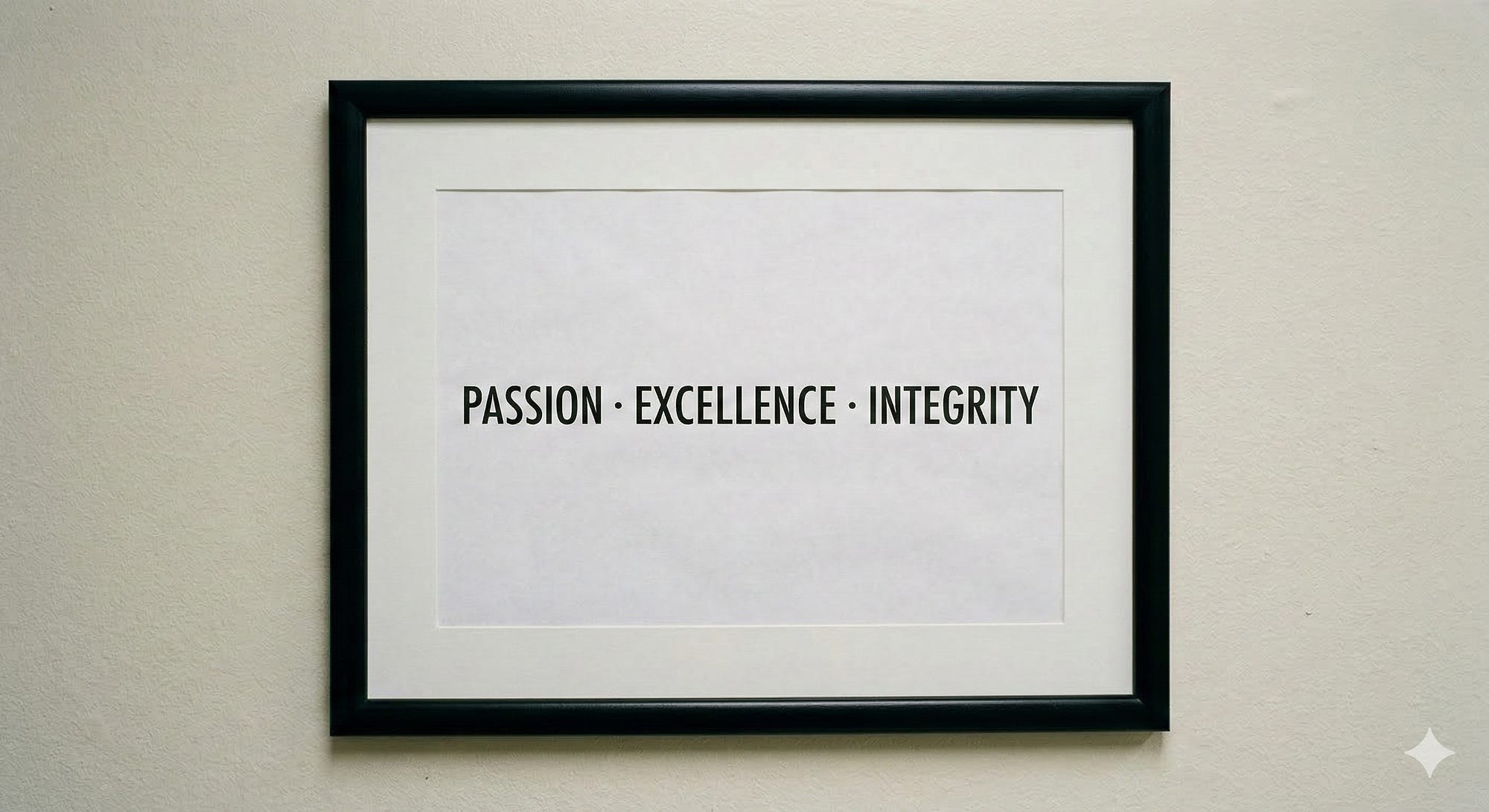
There is a ritual that most companies perform at some point in their life cycle, usually after a period of rapid growth or a moment of strategic anxiety, that goes roughly like this.
The leadership team takes a day off-site. There are Post-it notes. There are questions like “what do we stand for?” and “what makes us different?” There is a facilitator, or at least a particularly enthusiastic partner, steering the room towards something that sounds meaningful. By mid-afternoon, five to seven values have been identified, wordsmithed, and agreed upon. They are, in the language of these exercises, aspirational.
Back in the office, the values are framed and put in the kitchen. The website gets updated. The onboarding deck includes a new slide.
And then the company continues making exactly the decisions it was already making, for exactly the same reasons it was already making them.
This is a structural problem. And understanding why it keeps happening is the first step in building something that actually works differently.
Every firm has an essence: the lived belief system visible in the decisions it repeatedly makes. Most firms just haven’t found it yet. Or they’ve papered over it with something aspirational.
What Happens When the Foundation Is Missing
Consider two firms operating in the same market, serving broadly similar clients, offering what looks from the outside like broadly similar expertise.
Firm A has a values page that reads: passionate about technology, committed to client outcomes, driven by excellence. Nobody in the firm could tell you when those words were chosen or what decision they’ve ever changed. The partners are good people doing genuinely good work. But ask them to describe what makes them different from the firm down the road, and the conversation gets uncomfortable quickly. They reach for credentials. Service lines. Methodology names. Nothing quite lands.
Firm B tells you about a particular kind of problem. The one where everyone in the room already knows something isn’t working but nobody has found the language for it yet. They believe most digital transformations fail not because of bad technology but because of middle-management fear, and they’ve built their entire practice around that conviction. They only take on clients willing to let them report directly to the CEO. They walk away from six-figure engagements where that condition isn’t met. They describe, with some warmth, the specific clients they do their best work with and the ones they probably shouldn’t take on.
Firm B has not done anything flashy. They have not manufactured a differentiator. They have done something considerably harder: they have been honest about what is already true.
This honesty, once achieved, is commercially significant in ways the values exercise never is. Positioning, focus, storytelling, and everything else that follows in the system of becoming the obvious choice all depend on a foundation that is specific enough to build from. If the foundation is generic, everything built on it will be generic. The marketing will sound like every other firm’s marketing. The proposals will compete on the same dimensions as every other proposal. The growth will come from effort rather than gravity.
Essence is the foundation. Not metaphorically. Structurally.
What It Looks Like When It’s Working
The clearest examples of essence in action aren’t in the brand guidelines. They’re in the decisions that look strange from the outside and obvious from the inside.
The most visible cases tend to come from product companies, because their beliefs get built into things you can point at. But the principle is identical in services. The beliefs just show up in different places: in what you refuse to take on, how you price, which clients you walk away from, and what your people do when nobody’s watching.
Basecamp built an entire company around a single belief: that work should be calm. Not efficient. Not agile. Calm. That belief isn’t on a values poster. It’s in the product, which deliberately omits Gantt charts and complex dependencies, not because they couldn’t build them, but because building them would contradict what the firm actually believes. It’s in the pricing, which was designed around the principle that scaling charges as companies grow contradicts the belief. It’s in the books they’ve written and the features they’ve turned down. The essence isn’t claimed. It’s operational.
Linear reached a $400M valuation in 2023 on something even harder to articulate: taste. A belief in craft, in software that feels as good as it works, in empowering individuals rather than drowning them in process. At the time of their Series B, the founders reported spending around $30,000 on advertising. The product spread because the people who resonated with what Linear believed didn’t just use it. They identified with it. They invited their teams. Their teams invited others. The essence created a gravity that made every dollar of marketing work harder than a competitor’s hundred.
That recognition is the thing the values exercise never produces. Generic values attract nobody in particular. A specific belief, made visible in how you operate, becomes a signal. The right clients see it and think: these people understand my problem. The wrong clients see it and move on. Both outcomes are useful.
This is what distinguishes essence from branding. Branding is a claim. Essence is a filter. It doesn’t just shape how you talk about yourself. It shapes which opportunities you pursue, which you decline, and why every decision feels coherent rather than improvised.
The Archaeology Question
The excavation isn’t as mysterious as it sounds. It starts with a shift in the question being asked.
Instead of: what do we want to be known for?
Something closer to: what are we already doing, when we’re at our best, that no other firm does in quite the same way?
The answers tend to live in unglamorous places. In the decisions that were made without discussion because they were obvious to everyone in the room. In the work the team talks about that wasn’t on the brief. In the client relationships where something real happened and everyone knows it. In the projects that were turned down, and the thread connecting the reasons.
This is not a branding question. It’s a strategic one. A firm that genuinely understands its own essence has something rare: a filter. A way of evaluating every opportunity, every hire, every piece of communication against something true rather than something aspirational. The decisions become more coherent. The work becomes more recognisable. The clients who are right for the firm start to find it, because the signal it puts out is specific enough for them to recognise themselves in.
Which is how the obvious choice begins.
What the Future Looks Like for Firms That Get This Right (And Firms That Don’t)
Something is shifting in the market that makes this question more urgent than it has ever been.
In early 2026, McKinsey’s global managing partner described the firm’s workforce as 60,000: 40,000 humans and 20,000 AI agents. Internal tools now draft proposals, build slide decks, and write in the firm’s house style. One senior partner leading the firm’s AI efforts called it “existential for our profession.” The execution layer is being automated at a speed that would have seemed implausible three years ago.
This is not a McKinsey problem. It’s a professional services problem. The cost of competent execution is falling across every category. What clients will increasingly pay a premium for is not the ability to do the work but the ability to think about the problem in a way nobody else can. The judgment. The point of view. The specific understanding that comes from knowing exactly who you are and who you’re for.
The firms without a genuine essence will find themselves competing in a market where the floor keeps rising. More competitors can now deliver broadly equivalent work, faster and cheaper. The flexibility that felt like protection will feel like exposure.
The firms that have done the excavation work will find something different. Their essence is, by definition, uncopiable, because it’s built from what is genuinely and specifically true about them, not from a capability that can be commoditised or a methodology that can be replicated. The more the market compresses around undifferentiated competence, the more their specificity becomes an asset.
The firms that start the archaeology now will be further along the path by the time the pressure becomes undeniable. The ones that wait will be starting in a market where the space to be specific has narrowed considerably.
Essence is the fixed point.
This is where it starts.

Want to talk about your positioning?
We'd love to hear what you're working on.